
One checked number
Where to get help with gambling addiction
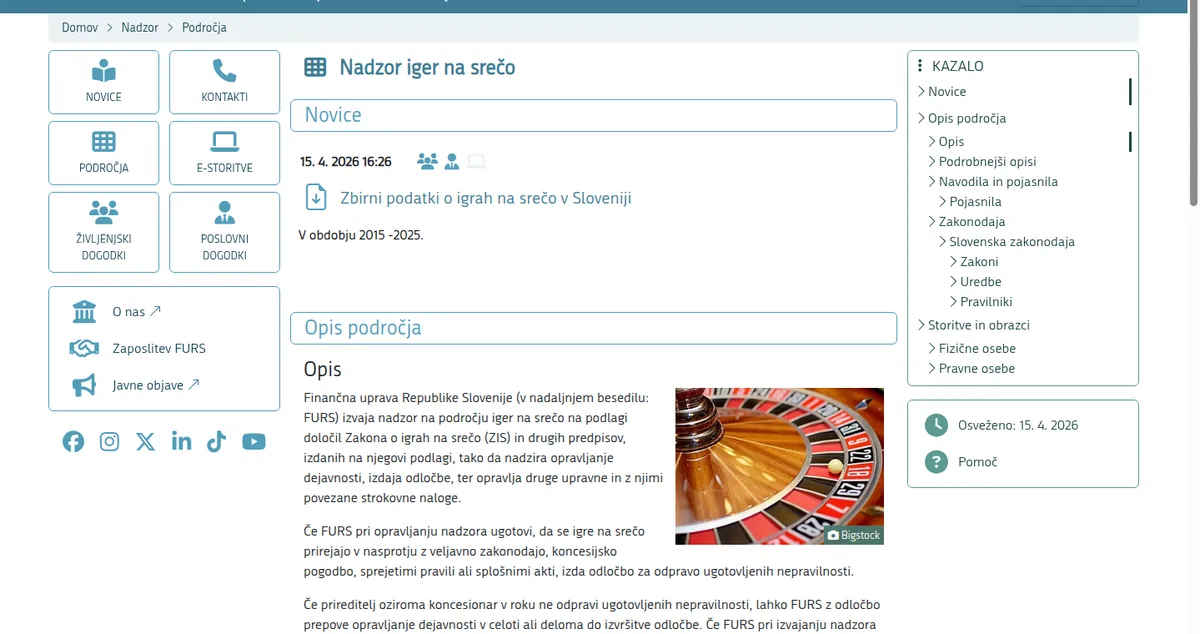
One telephone line has been checked: 040 88 99 18, every weekday between 10 a.m. and 3 p.m. Beside it, every player has tools they can set for themselves at the operator.
Anyone looking for help with gambling addiction should first know one checked number: 040 88 99 18, the confidential line of the Mladi hazarder project, reachable every weekday between 10 a.m. and 3 p.m. It is not the only thing available, but it is the only one we have checked far enough to publish without reservation.
Beside the number, this page also explains what a player can set for themselves at a given casino, before a problem arises at all. A comparison of the same terms of business at twelve casinos is gathered on the home page, online casino Slovenia.
One checked telephone line
The Mladi hazarder confidential line runs on 040 88 99 18, every weekday from 10 a.m. to 3 p.m. Three points belong beside that number in fairness:
- The 040 prefix is a mobile one. The call is charged at the caller's rate; this is not a free line in the sense of numbers with the 080 prefix.
- The project is aimed at younger callers. An older caller will probably still get a useful conversation, but they are not the programme's primary audience.
- It is a non-governmental programme. The service runs within a non-governmental organisation, not as a state telephone line.
Other numbers that circulate online as gambling helplines are deliberately not published here, because we could not verify with the provider itself that they operate.
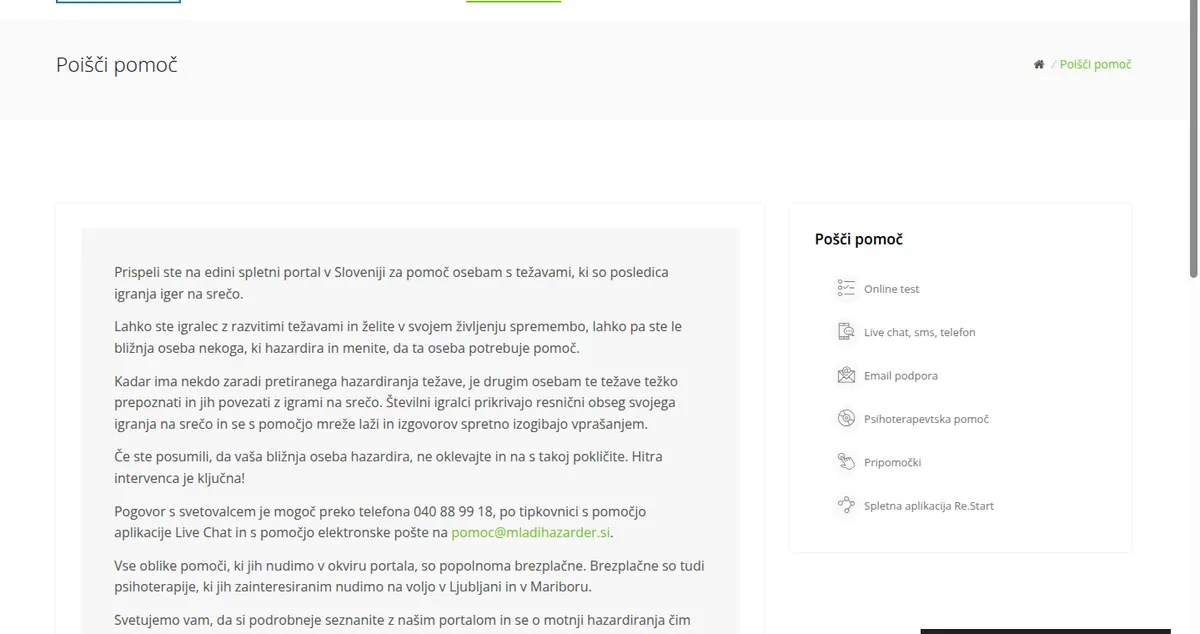
What it means that supervision is carried out by the Financial Administration
Supervision of the organisation of games of chance here is carried out by the Financial Administration (FURS), which matters chiefly for reporting an offer rather than for personal help with gambling problems; more about the statutory arrangement is on the page about the law and concessions.
What a player can set for themselves at the operator
Whatever foreign licence a casino runs on, most terms of business mention tools a player can switch on in their own account:
- A daily, weekly or monthly deposit limit. The player sets in advance an upper ceiling on the amount they can pay in over a given period.
- A session time limit. The account logs out automatically after a set time, or warns the player that it is time for a break.
- A temporary or permanent closure of the account. The player can ask for their account to be made unavailable to them for a set period or for good.
Whether, and in what form, each of the twelve casinos in the table actually offers those tools is not asserted here either way, because we did not read the responsible-play section systematically at every brand. Where a tool exists, it is as a rule described in the responsible-play section of the terms or in the account settings.
Why a setting at an operator differs from a state-run tool
A setting a player switches on at a given casino applies only to that account, not to every casino at once. That is an important difference from the state-run tools in some other countries, where a single setting applies at every provider in the market at the same time. At a casino running on a foreign licence rather than a domestic permit there is no such shared setting — every arrangement is made separately, with one brand.
For a player that means a limit agreed at one casino does not automatically apply at another. Anyone wanting a limit at several brands at once has to set it at each of them separately.
Why a self-imposed limit is not the same as self-exclusion
There is an important difference between the tools a player sets at an operator and tools a state would run. A setting at an operator is a contractual undertaking between a player and a single brand, and one the player can in principle cancel or change themselves, depending on the terms. A state-run tool would work independently of any operator's will and would usually apply for a longer, predetermined period.
That difference matters chiefly because a player who recognises in themselves a need for a stricter and more lasting limit may need more than a setting on one account — and there the most sensible first step is a conversation with a professional, not merely a change of setting.
What to do before setting a limit
Before switching on a limit or a session cap, note down where in the terms or in the account settings you found it, and when it started to apply. That note is useful if it later turns out the setting did not work as described — with a date and a place, it is easier to show what was actually chosen.
Where to find help with gambling addiction for someone close to you
Help with gambling addiction is not intended only for the player — often it is someone around them, who notices a change in behaviour, who needs it first. The Mladi hazarder confidential line on 040 88 99 18 is open to relatives and friends too, not only to the person playing; a conversation about how to raise the subject with someone close without pushing them away is often just as useful as a conversation with the player.
Anyone calling on another person's behalf should be prepared for the advice not to be an overnight solution — this is a long process in which a first call is a beginning, not a conclusion.
Why general help with gambling addiction does not replace financial advice
The advice a telephone line gives concentrates on behaviour and on the relationship with play, not on concrete financial decisions such as closing a bank account or arranging a debt. That needs separate professional help, to which the line itself can point you if it is needed.
Help with gambling addiction is therefore a first step and not the only one worth taking in a more serious case. What the casinos' own terms say about identity verification and withdrawals is gathered on the page about identity verification — useful reading before deciding to deposit at all.
When it is time for a conversation
Three signs are more reliable on this question than any amount lost: play starts taking money meant for something else; the stake rises to cover an earlier loss; the person lies about playing to the people closest to them. None of those signs is tied to a particular figure, which is why they are worth recognising before a loss grows large.
Anyone unsure whether what they have is already a problem has, in that doubt alone, reason enough to call 040 88 99 18.
A conversation with an adviser on that line does not require the player to name the casino or the size of the loss in advance — it is enough to describe what worries them. Many people put off calling precisely because they think they have to have exact figures ready; in truth a first conversation is mostly about working out together what the next step would be.
The same holds if you are unsure whether someone close has a serious problem or is going through a phase that will pass by itself — the adviser is used to conversations that end with the conclusion that no further steps are needed for now. No call is too small or too early a reason for a conversation.