
One page, every article in one place
Casino law in Slovenia: what the Gaming Act and the registers actually say
Casino law in Slovenia sits in the Gaming Act (ZIS), and this page gathers the articles most often misquoted on the subject, each with its source and reading date.
Casino law in Slovenia is a subject on which more inaccurate summaries circulate online than accurate ones. This page is the only place on the site where the Gaming Act, the register of concession holders, the supervisory authority and a comparison with two neighbouring arrangements are gathered together — all with the article, the source and the reading date stated.
The purpose of the page is not to pass judgement on whether play at a foreign brand is permitted or forbidden for an individual. The purpose is to show what the text of the law and the publicly available registers actually say, without adding an interpretation of our own where the law is unclear. The same approach to sources and dates governs the home page, online casino Slovenia, where the comparison of twelve profiles sits.
Why casino law in Slovenia is worth reading in the original
The question is often settled online with a translation of a foreign article, or with a summary that does not cite the article precisely. The Gaming Act is publicly available in full at pisrs.si, the official register of legislation, and every article on this page is taken from there. Where the text is quoted directly it is marked as a quotation; where it is summarised, the summary is limited to what the text actually says.
The reason casino law in Slovenia is handled on this one page, rather than spread across several, is simple: a reader after a single answer about the law gets it in one place, with a source and a reading date beside each statement, instead of assembling it from several different pages.
Who may organise games of chance in Slovenia
The first paragraph of article 3 of the Gaming Act says that organising games of chance is the exclusive right of the Republic of Slovenia, except where the act provides otherwise. The fifth paragraph of the same article sets the upper bound on those exceptions: classic games of chance may be organised on a permanent basis by at most two organisers, and for special games in casinos concessions may be granted for at most 15 casinos and 45 gaming parlours.
Online play is not a separate category in this. The first paragraph of article 3.a provides that games of chance over the internet may be organised only by companies that already hold a concession for classic games or for games in a casino, and only for the online game named expressly in their concession contract. There is therefore nowhere to file an application for a standalone online concession — it is always an addition to an existing concession, never a separate permit.
The total number of places the act allows for is thus limited: two organisers of classic games, up to 15 casinos and up to 45 gaming parlours. Not one of those places is online only — which is why casino law in Slovenia gives no different answer for an online offer than it does for a classic game: it is the same concession, merely extended to a further channel.
The third paragraph of the same article adds an obligation that applies once a concession is granted: the holder must connect its information system to the supervisory authority's system and give it read access to applications, data and system records. That obligation applies solely to concession holders inside the system, not to companies operating on a foreign licence outside it.
Who pays — the organiser, not the player
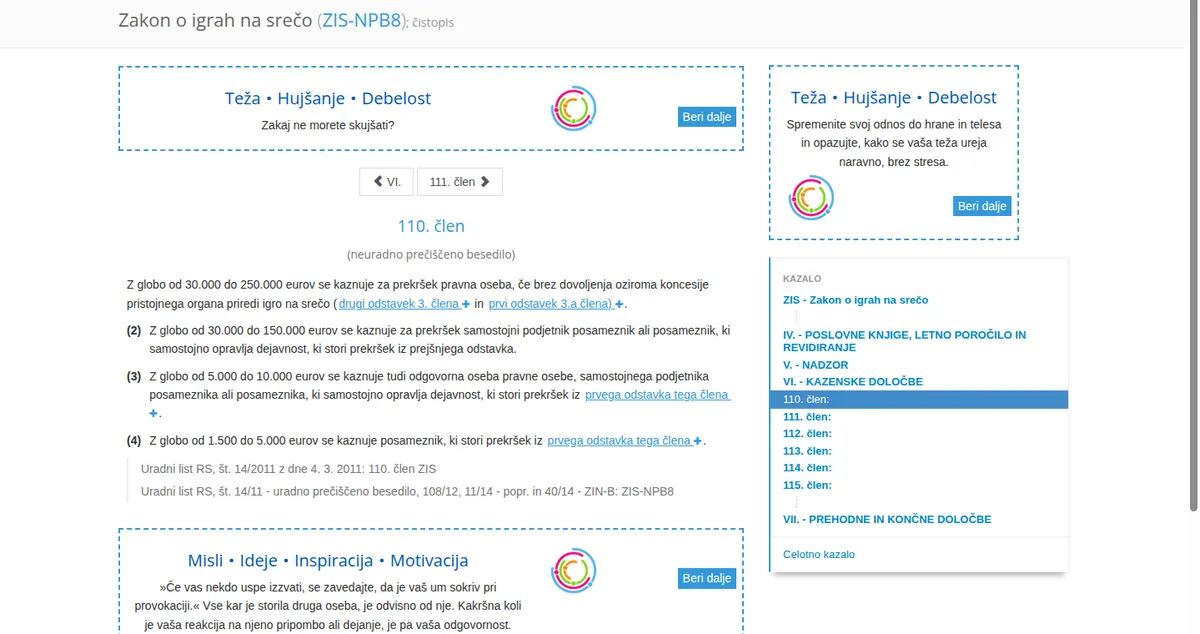
Article 110 of the Gaming Act is the provision websites most often attribute to the player. Its first paragraph punishes a legal person that organises a game of chance without a permit or concession, with a fine of 30,000 to 250,000 euros. The fourth paragraph carries the same conduct — organising — over to a natural person, with a fine of 1,500 to 5,000 euros.
The decisive word in all four paragraphs is the verb “organises”. What is punished is organising a game, not taking part in one as a player. The individual in the fourth paragraph is a natural person who organises a game of chance themselves without a permit — that is not a description of a player who deposits and plays at a foreign brand.
The two intervening paragraphs of the same article extend the circle of punishable persons to a sole trader and to the responsible person of a legal person — always in the role of whoever organises the game or answers for its organisation, never in the role of a customer taking part in it. Anyone reading that article as a provision against players is reading it wrongly: the subject of all four paragraphs is the organiser in one of four legal forms.
Article 7 of the Gaming Act, which websites also like to cite as evidence against the player, is built on the same pattern. It forbids accepting payments and promising winnings to persons without the appropriate permit — and both acts, accepting and promising, are carried out solely by the provider, not by a player who pays in or receives a win.
When taking part is an offence at all
The Gaming Act knows one single narrow provision that directly limits participation in a game, and it applies solely to employees. Article 86 forbids a worker to play at the concession holder that employs them. Article 119 sets a fine of 500 to 3,500 euros for breaching that prohibition.
The circle of people the prohibition covers is therefore bounded in advance to employees of the same concession holder, not to players in general. For a player who is not employed by any concession holder and who plays at a brand with no Slovenian concession, that particular provision does not apply.
The act also provides, in article 83, that entry to a casino is permitted only to persons aged at least 18, which is a provision about access to the physical premises of a casino, not about taking part in an online game at a foreign brand. None of those provisions — article 83, 86 or 119 — describes a general prohibition on a player who merely plays at a foreign online brand.
Who actually supervises today
The text of the second paragraph of article 3.a of the Gaming Act still speaks of the “Tax Administration of the Republic of Slovenia” as the supervisory authority — a name that no longer officially exists. The specialised office that once dealt separately with supervising the organisation of games of chance has been abolished and does not operate today; a page naming that office as a working authority has therefore not been updated.
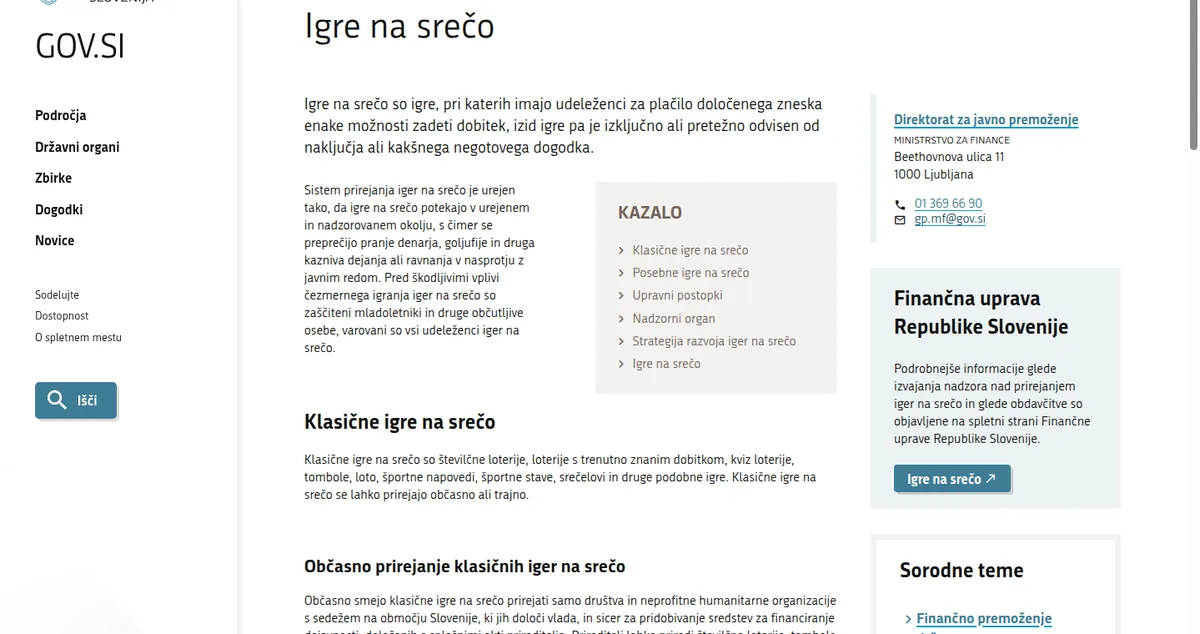
The Financial Administration of the Republic of Slovenia (FURS) states on its own site that supervision in the field of games of chance is carried out by it, which the central gov.si page confirms (read on 8 September 2026). Concessions are granted by the government, while the administrative part of the procedure and the registers are run by the Ministry of Finance under the sixth paragraph of article 3.
What is published on gov.si, and what is not
Four register extracts are published in PDF form on the central gov.si page (read 8–13 September 2026): the register of organisers of classic games of chance, the register of casino concession holders, the register of gaming-parlour concession holders and the register of concession holders for organising online games of chance in a casino.
All four extracts list companies that do hold a permit or a concession — a whitelist, not a blacklist. No list of blocked domains or casinos is published on gov.si, and the same holds for the register of the foreign licence issuer each casino in our table relies on.
How a block on an individual domain arises
The Financial Administration describes on its site the procedure by which access to an individual site can nevertheless become restricted: “If an infringer organising games of chance over the internet does not comply with a decision prohibiting the organisation of a game of chance, FURS may propose to the court that an information-society service provider be ordered to restrict access to the websites.”
The sequence therefore runs in three stages: a decision prohibiting the activity, non-compliance with it, a proposal to the court. Each step runs against the organiser as a legal person, not against the player, and none of the steps runs through a publicly published list — a block arises individually, for each domain separately, through an administrative and a judicial procedure.
For a reader that means two things. First, a domain that works today can become unreachable tomorrow with no general announcement published in advance. Second, because the procedure runs against a company and not against a player, a block does not in itself mean that a player who played at that brand has been sanctioned in any way. Where it is possible to turn in a dispute with an operator is set out on the page about a dispute with an operator without a concession.
The self-exclusion register we did not find
Besides the register of concession holders, we looked for a national self-exclusion register — a list of people who have asked for play to be made unavailable to them, and which an organiser would have to check before accepting a player. We found no such register on the central gov.si page or in the four published register extracts; all four list companies, not individuals.
That is a finding from our reading on the day of checking, not a final assertion that no such register exists in any form. If it is published somewhere we overlooked, this page will be corrected by the procedure described on the page about the methodology for reading terms. Where a player who recognises a problem with their own play can turn, whatever the law says about it, is explained on the page about help with gambling addiction.
Why a concession and a foreign licence are not the same thing
The word “licence” often misleads on this subject, because it comes from arrangements where a permit goes to anyone meeting publicly published conditions. The Slovenian mechanism is a concession: a contract between the state and a particular company, concluded at the discretion of the government and the minister, not on automatic satisfaction of criteria. The third paragraph of article 3 does not say that a concession falls to whoever meets the criteria — it says only what the government and the minister take into account when deciding: market saturation, sustainable development, social and environmental effects, justification in tourism terms, the applicant's experience, its financial capacity and its settled tax obligations.
A casino naming a licence from the Curaçao Gaming Authority or the Anjouan Gaming Board therefore holds no equivalent of a Slovenian concession, but a permit of an entirely different kind, issued under another country's rules; how such a licence is checked and what it proves is explained on the page about foreign licences. In the Slovenian sense of the word, a casino without a licence means one without a Slovenian concession — it does not necessarily mean one without any foreign permit at all.
How Poland and Portugal answer the same question
A comparison with two neighbouring arrangements shows that the Gaming Act is not the only possible approach. Poland's fiscal penal code, in article 107, § 2, also punishes a person who takes part on Polish territory in a foreign game of chance or a foreign bet, with a fine of up to 720 daily amounts or imprisonment of up to two years, or both. Poland therefore expressly defines a player's participation as punishable conduct, which the Gaming Act does not do for a player who is not employed by a concession holder.
The Portuguese arrangement takes a third route: it defines play at an unlicensed company's site as a minor offence punishable by a fine, up to 2,500 euros for a natural person. That is an administrative sanction rather than a criminal act, and an administrative rather than a criminal procedure. Three systems therefore answer the same question — what happens to the player — differently, which is why summaries from foreign texts cannot simply be carried across a border.
The range between the three arrangements is wide: at one end imprisonment of up to two years under Polish law, at the other an administrative fine of up to 2,500 euros under Portuguese law, and on the Slovenian side neither of those two routes for a player who is not employed by a concession holder. A translation of a Polish or Portuguese article about “penalties for players” would carry over to a Slovenian reader a rule that simply does not exist in the Gaming Act — the commonest error that appears online on this subject.
What this means for a reader
Something concrete follows from the articles gathered here, and something deliberately stays open. The concrete part is that article 110 punishes organising rather than participating, and that article 119 limits participation solely to employees of a concession holder. What stays open is the question of what happens to money in an account at a foreign company if a domain is blocked — the Gaming Act does not answer that, because it answers only the question about offences.
This page does not advise how to avoid any of the procedures described, and does not assess whether play at a foreign brand is a suitable choice for a reader. It states only what the text says, with the article and the date beside each statement.
What happens if the law or a register changes
The Gaming Act and the registers on gov.si are not static documents. The act can be amended, and the register extracts are updated independently of the statutory text. Whenever a statement on this page turns out to be out of date, it is replaced by a correction carrying a new reading date — the old text is not left published alongside the new, because that would mislead the reader.
The same rule holds for the comparison with Poland and Portugal: both foreign rules can change independently of the Gaming Act, which is why the reading date is given for them too, not only for the Slovenian part of the page.